Personal Intelligence System
GRAYDRAGON
A local-first AI and automation system that helps me think, remember, organize, automate, and operate my digital life.
- Status
- ACTIVE
- Host
- UBUNTU
- Deployment
- SELF-HOSTED
Overview
System Overview
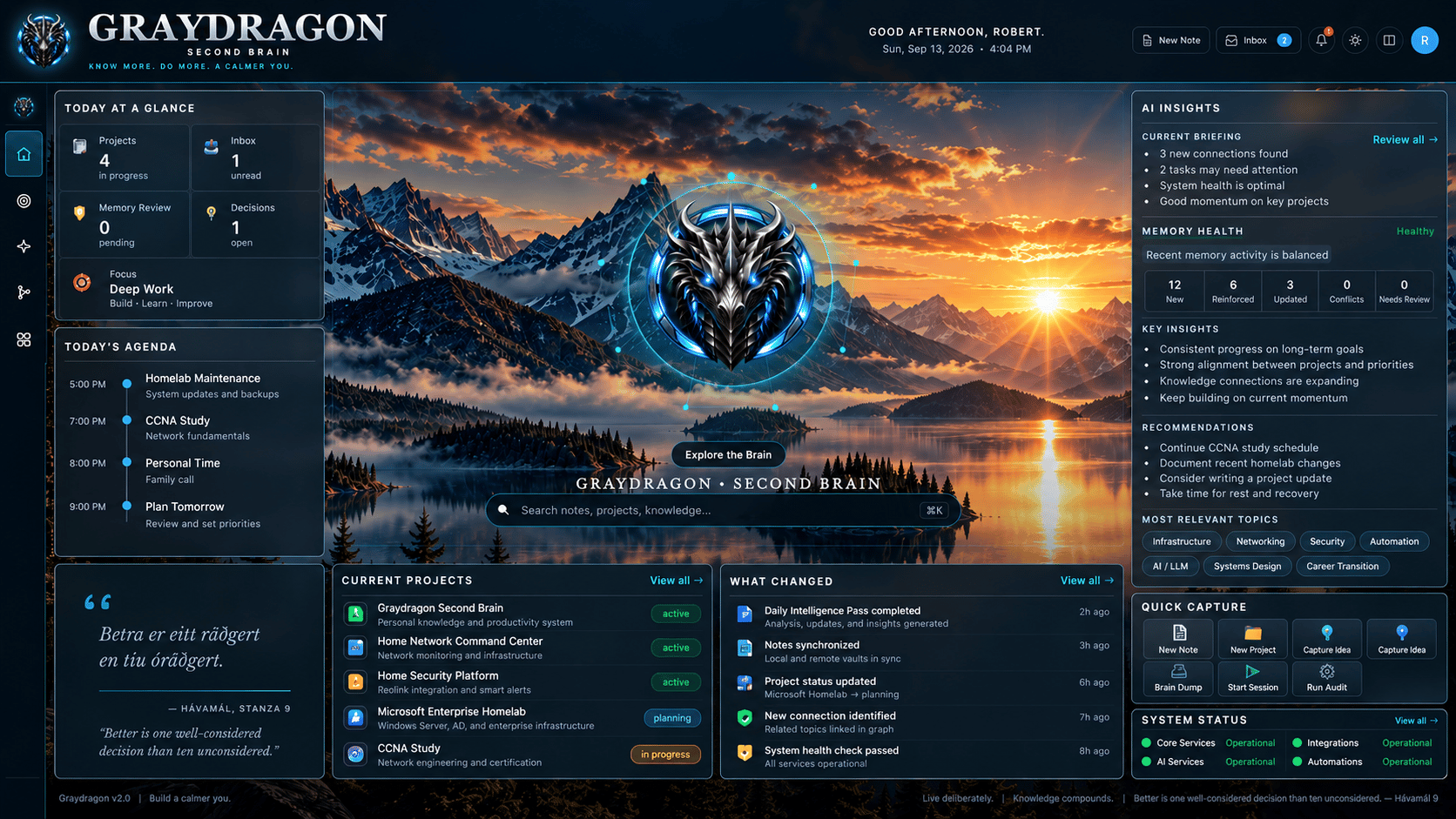
Graydragon is a personal operating system and AI-assisted second brain designed to help manage attention, memory, waiting-on items, daily context, automation, email, calendar data, and local intelligence processing. It combines software automation, local AI infrastructure, system services, dashboards, APIs, and connected data.
GPU
NVIDIA GTX 1080 8GB
MODEL
Qwen3-8B Q3_K_L
INFERENCE
llama.cpp CUDA
API
OpenAI-compatible
CONTEXT
4096 tokens
The system is being intentionally designed to reduce dependence on third-party AI APIs while retaining provider flexibility. Graydragon is under active, ongoing development, with new capabilities shipping regularly.
Problem
The Problem
- ›Attention, memory, and daily context get scattered across email, calendars, notes, and half-finished automations.
- ›Most 'productivity' tools require manually feeding them information instead of pulling from where the information already lives.
- ›Relying entirely on third-party AI APIs creates cost, privacy, and availability tradeoffs for something meant to run every day.
Requirements
What It Had to Do
- ›Pull real context automatically from Gmail and Calendar rather than requiring manual entry.
- ›Generate a daily brief that reflects what actually needs attention.
- ›Run core intelligence processing locally, with the option to fall back to hosted providers.
- ›Track waiting-on items and follow-ups without needing a separate task manager.
- ›Run as reliable, restart-safe Linux services rather than scripts babysat by hand.
- ›Expose a dashboard for system health so failures are visible instead of silent.
Architecture
How It's Structured
Build
Engineering the Build
The system is organized around a local vault of notes and state, a set of automation scripts that pull from Gmail and Calendar, and an AI provider abstraction layer that can route requests to either the local Graydragon AI server or a hosted provider.
The Graydragon AI server runs llama.cpp with CUDA acceleration on an NVIDIA GTX 1080, serving a Qwen3-8B model behind an OpenAI-compatible API so the rest of the system doesn't need to know which provider is answering.
Daily processing runs as scheduled Linux systemd services: pulling mail and calendar data, generating a brief, updating the vault, and validating that the pipeline actually ran instead of assuming it did.
A dashboard surfaces system and service health so problems in the pipeline are visible rather than discovered days later.
Challenges
What Made It Hard
- ›Designing a provider abstraction that treats local and hosted AI as interchangeable, without hard-coding assumptions from either.
- ›Keeping a local 8GB-GPU model useful within a 4096-token context window for real daily-use tasks.
- ›Making automation trustworthy enough to run unattended — including validating that scheduled jobs actually completed, not just that they were scheduled.
Current System
Results — Where It Stands Today
- ›Daily intelligence processing, Gmail and Calendar integration, and automated brief generation are running in production as systemd services.
- ›Local AI infrastructure serves inference through an OpenAI-compatible endpoint, with provider abstraction in place to swap or add providers.
- ›A dashboard reports system and service health, and scheduled jobs include production validation checks.
What's Next
What's Next
- ›Expand local-first personal knowledge processing to reduce reliance on hosted AI providers further while keeping provider flexibility.
- ›Broaden automation coverage beyond email and calendar into other recurring personal-operations tasks.
- ›Continue hardening the dashboard and monitoring around the AI provider layer.