Context-Aware Security Platform
HOME SECURITY
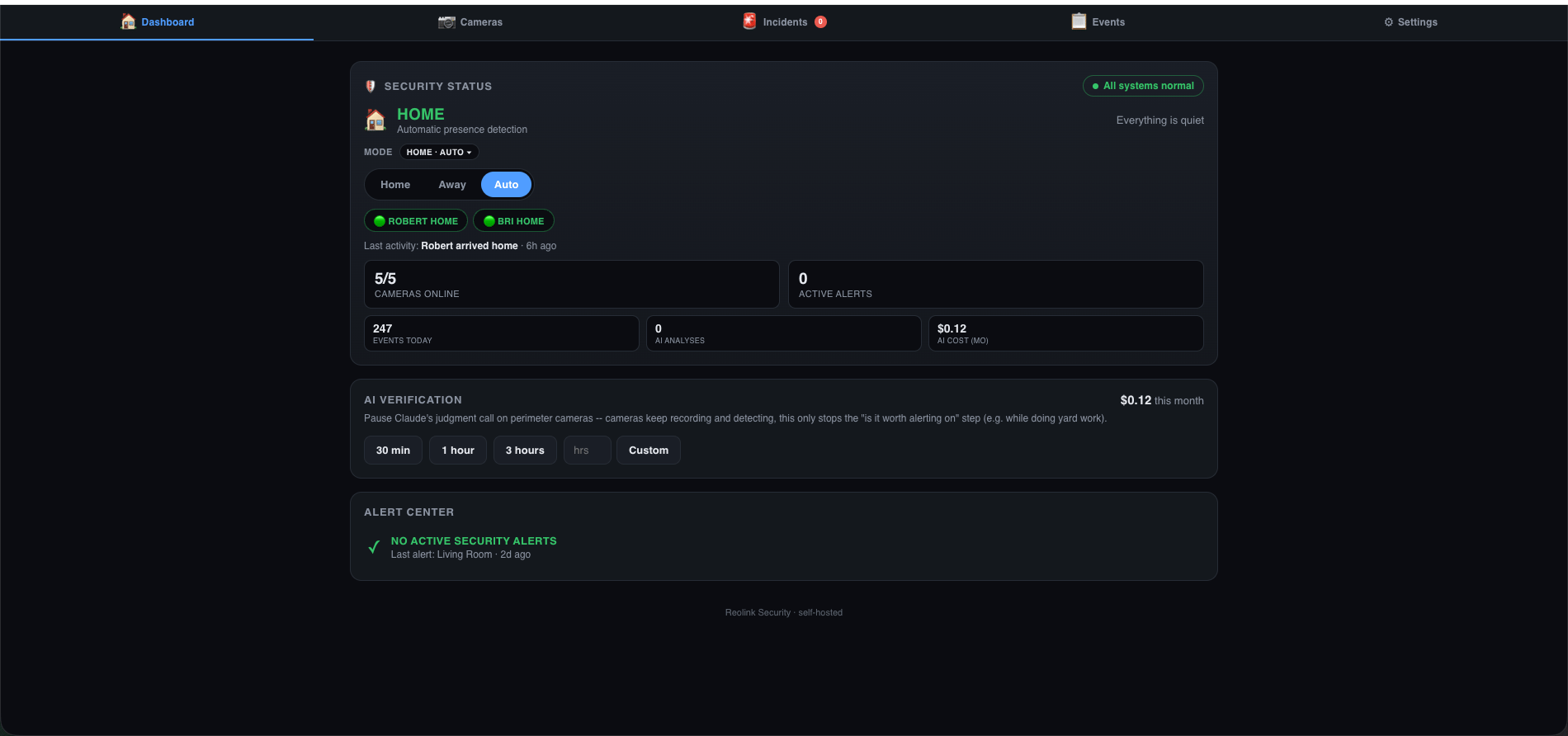
An intelligent home security platform combining cameras, presence detection, incident correlation, zones, trusted people, vehicle recognition, and AI verification.
- Status
- ACTIVE
- Host
- UBUNTU
- Deployment
- SELF-HOSTED
Overview
System Overview
A custom Reolink-based security platform designed to understand context rather than simply generate motion alerts. It correlates camera activity with presence, zones, known people, and known vehicles to decide what actually deserves attention.
Problem
The Problem
- ›Motion-based security alerts are noisy: wind, headlights, and pets generate the same alert as an actual event.
- ›Alert fatigue means real events get ignored along with the false ones.
- ›Most consumer security systems have no concept of who is normally present, so they can't tell 'someone I know' from 'someone unknown.'
Requirements
What It Had to Do
- ›Correlate camera detections with zones so an event's location carries meaning, not just 'motion somewhere.'
- ›Track resident presence — including Wi-Fi/MAC-based detection and manual override — to establish house-level occupancy state.
- ›Support distinct security modes (HOME, AWAY, NIGHT, GUEST, VACATION) that change how events are evaluated.
- ›Maintain a trusted people and known/authorized vehicle list to reduce false positives from expected activity.
- ›Run detections through an AI verification step before escalating to a human-facing alert.
- ›Give incidents a real lifecycle (OPEN, QUIET, RESOLVED) instead of a single fire-and-forget notification.
Architecture
How It's Structured
Build
Engineering the Build
Camera feeds and detections come from a Reolink camera topology, normalized into a common detection format regardless of which camera generated the event.
Detections are mapped to zones, and cross-referenced against a presence engine that tracks arrivals, departures, Wi-Fi/MAC presence, and manual overrides to compute a house-level occupancy state and a presence confidence score.
An incident engine correlates detections, zone, and presence context, applies the active security mode, and checks the event against trusted people and known/authorized vehicles before deciding whether it warrants AI verification.
Events that pass verification are escalated as incidents with a lifecycle — OPEN when new, QUIET once acknowledged or expected, RESOLVED once closed out — instead of a single alert with no state.
Challenges
What Made It Hard
- ›Resolving presence conflicts — for example, a phone reporting 'home' while a camera detects nobody in expected zones.
- ›Suppressing alerts for context that is genuinely benign without suppressing alerts for events that only look benign.
- ›Keeping the trusted people, known vehicle, and zone data current enough that the system doesn't quietly go stale.
Current System
Results — Where It Stands Today
- ›Camera health monitoring, zones, presence detection (including Wi-Fi/MAC and manual override), and security modes are running.
- ›Incident correlation and the OPEN / QUIET / RESOLVED lifecycle are in place, with trusted people and known/authorized vehicle lists feeding suppression logic.
- ›AI verification sits in the pipeline before alerts are escalated, aimed at reducing meaningless notifications while preserving awareness of events that matter.
What's Next
What's Next
- ›Continue refining presence-conflict detection between device-based and camera-based signals.
- ›Expand known-vehicle and authorized-visitor handling for less common scenarios (deliveries, service visits).
- ›Tighten AI verification accuracy to further reduce false suppressions and false escalations.